Sunday, January 4, 2015

FROM THE OLD YEAR TO THE NEW YEAR

EARLY ON IN THE NEW YEAR

And a bit from late in the old year, too

The transition from 2014 to 2015 was seamless.  The weather is relatively mild for a change ("mild" being no single digit temperatures yet) and in spite of the snow we've had already, we just had a couple days of rain.  2014 saw us out with snow and 2015 saw us in with rain and fog.  I'll take it!


HAPPY NEW YEAR!


This time of year there is a lot going on in the outdoors and plenty to look at and appreciate in our locale.  Winter is a time of sleep for many creatures and plants, but if you feed birds you know how active feeders can be.  

 We often get wild turkeys (I should say living vacuum cleaners) gleaning the seeds that fall from hanging feeders or hopping up on the table where I throw black oil sunflower seeds, peanuts, and shelled corn.  They are HUGE birds!  I allow them some time to get a fair feeding then chase them.  Last year they got so accustomed to me running out the door shouting, "Git!  Go on!" and waving my arms that they hardly moved away; maybe they retreated 20 feet or so then came right back.

Wild turkeys were almost driven to extinction because they are such an excellent food source.  They've made a nice comeback, however, and are now living in every state except Alaska.  Yes, even Hawaii has wild turkeys.  They were introduced to the islands as early as 1788 and are now quite common.

Pretty much everyone knows what a wild turkey looks like, but surprisingly few see them in their wild habitat.  The guy below is a "Tom" (male) and he has a beard to prove it.  See the tuft of feathers that look like hair at the base of his neck?  That is the beard.  The father is no help whatsoever in raising the young.  The babies follow their mommy hen until they are old enough to strike out on their own in a group with other youngsters.  Turkeys are strong fliers but anecdotal experience tells me they prefer to run like the wind as long as that works.  They are wonderful birds.  

Read more here:  

http://www.allaboutbirds.org/guide/Wild_Turkey/lifehistory

Turkey for dinner again????


Taking advantage of the local buffet luncheon

These are in their natural habitat.  They are so thorough when scratching to find food that the ground is bare when they're done.

I have a bunch of pictures of winter birds for a post a little later, but here are a couple for your enjoyment.


First is the White-throated Sparrow, a pretty small songbird with a bright white throat (DUH!)  There is a relatively small swath of North America where they don't occur, but they are a common sight in the majority of the USA and Canada.  Their song is described as sounding like "oh-sweet-canada".  These sparrows usually nest on the ground unless their first nest is destroyed by predators; then they will build higher up in a tree for a second try.  Although common, they are declining in numbers. 

Read more here:
http://www.allaboutbirds.org/guide/White-throated_Sparrow/lifehistory

White-throated Sparrow showing the reason for it's name.

The bird below is a Dark-eyed Junco, sometimes called a snowbird because they appear as winter set in.  They are not to be confused with senior citizens who move to Florida!


Juncos are a kind of sparrow.  They are ground feeders but can be seen at feeders.  Ours are more often on the ground under the feeders cleaning up after the sloppy titmice and chickadees.

 Read more here:

http://www.allaboutbirds.org/guide/dark-eyed_junco/lifehistory

This is a male - dark gray with a white belly and pink bill.  Females are more brown, but color is variable and these birds in Oregon have tan on them.

There is a lot of brown in winter but it isn't all dull and dreary.  These graceful grasses grow by the road.  The seeds are long gone but the lovely seed heads remain.


Some ferns are evergreen, others die off until springtime, and some live in a kind of half-sleep until awakend by the warming sun and milder temperatures.

I LOVE CATTAILS!  They are a wetland plant that needs wet feet to thrive.  They grow up to 10 feet in height and can become overbearing if not kept in check.  They are a favorite home for Red-winged Blackbirds (see below the picture of cattails).

More info here:  http://www.cattails.info/

The male Red-winged Blackbird is jet black with bright red and yellow wing bars.  As much as we ohh and ahh over the males, I prefer the understate beauty of the females.

For more information on Red-winged Blackbirds, read this:

 http://www.allaboutbirds.org/guide/Red-winged_Blackbird/id

Female

Male

Let me introduce you to a greatly-respected scientist and blogger,

Charley Eiseman

described in his own words as

. . . a freelance naturalist, endlessly fascinated by the interconnections of all the living and nonliving things around me. I am the lead author of Tracks & Sign of Insects and Other Invertebrates (Stackpole Books, 2010), and continue to collect photographs and information on this subject. These days I am especially drawn to galls, leaf mines, and other plant-insect interactions.

His posts enthrall me.  Many of the things he studies we don't even have on our radar, like leaf miners, tier moths, leaf rollers.  His knowledge is deep and wide when it comes to the eggs, nests, tracks, plant galls, and more of insects and invertebrates.  If you  love learning about these strange and wonderful things that are born, live, mate, and die right under your nose without you being aware of them, read his blog.  

The most recent post is here:

https://bugtracks.wordpress.com/

Another of my favorite things in the whole world ever is milkweed!  There are many kinds of milkweed and it lives in a number of different habitats from almost arid to the edges of lakes and in marshes.  It does need sunshine to be really happy, and it smells delicious when blooming.  This is the food plant of the monarch butterfly (more on them in a later post) and it is in trouble.  Milkweed is dying off which is a terrible problem for not just the Monarchs but for insects of many kinds and the spiders and wasps that feed on them.  If you have a sunny place where you can plant milkweed, please do.


Here are some pictures I took in the fog this morning.  As the fog rolled in getting thicker and thicker, it was hugely symbolic to me of a way of life that is rapidly disappearing into the fog of "yesterday".  The small farmer is struggling to keep a place in our modern world.  Around us many farms are being preserved, which is good news.  The not-so-good news is many more are not.  I hope scenes like this remain with us for a long, long time. 


Wishing all of you a bountiful, productive, and marvelous 2015.

Wednesday, December 17, 2014

WHATEVER YOU DO OR DO NOT CELEBRATE, I WISH YOU JOY!

A WISH FOR THE HOLIDAYS

As we get close to the end of 2014, it seems the time passed in the blink of an eye.  Here we stand on the brink of a whole new, fresh, clean year filled with possibilities; the old year is a bit ragged but there is value in revisiting it.

I, for one, am grateful to 2014.  It brought me to this blog and you.  Thank you. 

This post is mostly about the color red - some white and some green are mixed in.  For those of you who celebrate Christmas, red is a prominent color of the season.  For those who celebrate other holidays or even no holiday at all, red is cheery and fun.  

 To all of you, I hope this time of year brings happiness.

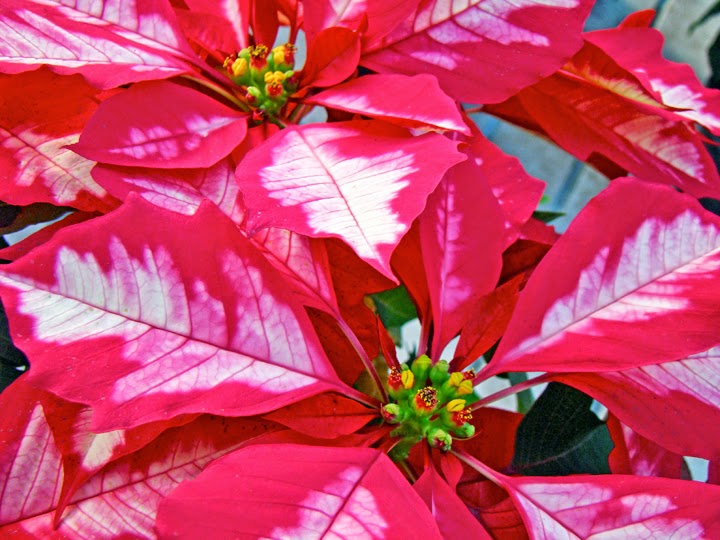
  Poinsettias are one of the most popular holiday plants.  As the years went by, the red poinsettia gave way to almost every color imaginable (or combinations thereof) except the blue range.  Many of the plants are grown in Canada where they are shown, judged, and and chosen for market.  I have an artist friend in Ontario who goes to these exhibitions and does judging.  Gardeners look for traits to make the plants more salable, like stems that grow more upward and resist being broken when placed in cellophane sleeves.  Colors are favored or rejected; size and fullness are scrutinized.  All this so you and I can go to the greenhouse or supermarket and buy some of the most beautiful holiday plants offered.

 I went to Ott's Exotic Greenhouse and photographed 20 different varieties - all lovely, all lush and healthy.  Here are just a tiny few of those poinsettias.


 The Christmas, or Holiday Cactus is another favorite plant that is used for gifting or decorating during this holiday season.  Again, the colors available expanded from the red, pink, and white to many others in between.  This particular one caught my eye because the flower looks like a swan - at least to me:>)

 Another splendid plant, one not necessarily paired with the holidays but festive nonetheless, is the hibiscus.  


Rose Of Sharon Hibiscus Family Member

Up Close and Personal with a Red Hibiscus

Orchids can join the many fancy plants considered tough to grow that now enjoy enhanced popularity as ordinary houseplants.  They, too, can be found in an ever-increasing array of colors.  Here is red and white specimen followed by a soft yellow-white flowered orchid.


RED!  Glorious, riotous red.  Here are a couple kinds of Clematis that will warm any heart.

Tiny, white star clematis grown with red poinsettia

The heart of a red clematis

Meet the exquisite cyclamen - this one in white.  They are now found from teacup size to HUGE.  The flowers are all over the place with different colors, except the blue tones.  Can the blues be far behind???


I believe this is a Mimosa flower - some call it a "Sensitive" Tree because touching the leaves makes them close up.


http://en.wikipedia.org/wiki/Night-blooming_cereus

 Love of roses is almost universal, and the red rose is an all-time favorite.


This white beauty is commonly called Queen Of The Night or Night Blooming Cereus.  It's a desert cactus that blooms only for one night but what a sight!  This flower is the size of a dinner plate and, once opened, the fragrance is awesome.


I'll leave you with three winter scenes from the Green Lane, Pennsylvania, USA area.  Our southern hemisphere friends  are experiencing springtime and summer is not far away.  We have bare trees and, often, snow:>)

 
The day before Thanksgiving (late November 2014)


A snowstorm at the creek

Happy holidays to everyone and a very health, productive, and happy New Year!

Carol & Family (including Spot)


Sunday, November 9, 2014

I'm Back:>)

LET'S HAVE SOME FERN!


Life is crazy - for you, too, I imagine -  but I missed the blog.  This is a brief, not fancy "hello" and a way for me to re-acclimate.  Writing the blog is a way for me to engage with people and share the wonders of our little portion of the natural world.  

Sometimes I write about things other than those delights I see on a walk.  I think the next blog, the more lengthy one, will be on SPOT THE MAGNIFICENT.  Spot is our kitten, the little guy we adopted in June of this year.  He was feral, terrified, and impossible.  Now he's a true "pussycat" - a sweetheart.  It's possible what we learned and experienced could help someone else.

Meantime, "HELLO!  I MISSED YOU:>)"

These ferns are not named; enjoy the lovely greenery, even when it's black and white:>)

Springtime brings us "fiddleheads", the newly growing fern fronds.

Summer is wonderful around here!  Anywhere there is moisture and dappled sunshine there are ferns.  Some are feathery and delicate, some more solid-looking, and others tall and graceful.  I counted no less than 8 kinds of ferns on a walk of about a mile.  The Season was late summer when things are doing well and pretty much grown.


This next picture shows the home of either a moth or a tier caterpillar.  I tried tying cheesecloth over it to see what emerged, but I must have been too late - nothing emerged and nothing was in the "house" when I later examined it.  This was beautifully woven and tightly stitched together with silk - an engineering marvel done by a humble, little larva of some sort.  AWESOME!


Over the course of the many years we've lived here, I collected an occasional wildflower and replanted it in my wildflower garden.  I never dug up a plant that wasn't endangered by construction or some other disaster (spraying plant killer on the power lines by the Electric Company counts as a disaster), and some didn't make it through the transition.  Many wild plants have specific symbiotic relationships with other plants or organisms that thrive in the same area.  Moving them can also take them away from the partners that make the plants healthy and viable and allow them to thrive.  The best ways to capture beautiful wildflowers for your garden is to gather seeds (you'll need to do some research on what to look for and when), take a cutting (can be very difficult), or buy from a reliable source.  There are many on the internet that sell almost any wildflower your heart desires.

Now that was a bit off the subject:>)

This last picture is my wildflower garden in autumn.  Fall is the time of settling in for the winter's nap, a time when colors are both lost and and enhanced.  


There will be another blog post soon.  Meantime, thank you so very much for taking time to come by.

Have a wonderful week!


Wednesday, August 20, 2014

A Little This ~ A Little That

Odds & Ends

 Although life is busy and I'm officially off my regular posting schedule, I miss you:>)  Once sanity returns and everything is back to normal, I'll post each Friday once again.  For today, however, I'm going to focus on showing you some pictures.  I hope you enjoy this post; it's different from what I normally do with nature and information regarding our subjects.

Life is filled with amusing moments, and this picture is one example.  My husband and I were running errands in another town, and we saw this sign.  It isn't one we've seen before and it made us laugh.  A sense of humor, even by a local borough police department, goes a long way to getting cooperation.

Self-explanatory - LOL
Chocolate Slime Mold isn't something I find all the time, and finding it on a decaying stump was like finding a treasure.  Slime molds are not fungi and they are not plants.  They are also not exactly animals, so what are they?  

They begin life as spores and are single-celled amoeboid protists crawling around looking for food.  Eventually they merge with others like them and form one big cell with lots and lots of nuclei.  They transform into a spore-making body to reproduce, and this picture is of that stage in their life.

The name Protista means "the very first", and these are very elemental, early life forms.  Check this out:  http://biology.unm.edu/ccouncil/Biology_203/Summaries/Protists.htm  

Amoebas are single-celled animals (  http://www.fcps.edu/islandcreekes/ecology/amoeba.htm  ).

http://www.ucmp.berkeley.edu/protista/slimemolds.html
For a couple years I've been dreaming of a lens that could take excellent pictures of birds. Of course the photographer has more to do with it than the lens, but even so . . .  I went to Cardinal Camera and spent some time talking to the youngsters who man the store (excellent photographers and extremely helpful without any hard sell).  We decided I could improve by using a Tamron lens, 150 - 600.  The cost was around $1,800.00, and it was so new that I had to prepay and wait for 2 months to get it.  The serial number is in the mid 3 digits!! Me!  I got one of the first!  YAY!

When it came in and I went to pick it up, I knew immediately it was too heavy for me to hold.  I didn't have a tripod and didn't want one, so I purchased a monopod - a stick with a place to attach the camera on one end.  It worked, but the lens was still too heavy for me to manage.  I did, eventually, buy a tripod.  

Today I went outside and got set up in a place where I could see the hummingbirds like to sit and catch a breath.  I need more days to practice, but there is one photo to share with you.  This is an immature female - no ruby throat.  The fancy feathers are reserved for the guys.

By the way, the Tamron lens is magnificent even if it did take every last penny I'd saved for a new lens.

Ruby-throated Hummingbird 

http://www.allaboutbirds.org/guide/ruby-throated_hummingbird/id
Now, on to a totally different theme - messing around with pictures to make them "artsy-fartsy".  Most of my family and some of my friends just HATE when I do this.  It's fun.  In case anyone is interested in this process, I'm going to show a few.  This is just a flight of fancy on my part; light-hearted fun:>)

Although some enhanced photos get mixed into the regular blog posts, they are not included there because of the enhancements but because they fit a subject. 

First is a picture of the Asian Dayflower wildflower.  The original and two enhanced versions are below.  (  http://plants.usda.gov/core/profile?symbol=COCO3  )

Asian Dayflower - Original picture

This has two layers of what is called "texture work" melded into the original photo.

This has a "frame" and a couple layers for color changes and subtle textures.


This next picture began life as a simple photo of some of our tomatoes.  The old fruit crate labels are, in my opinion, charming, and old seed packets are similarly attractive.  I made the picture into a fantasy seed packet.


Thistle seeds are beautiful - so delicate and light.  This picture got the softening treatment and most of the color was removed.  I then tinted the picture a gentle taupe.  (  http://en.wikipedia.org/wiki/Thistle  )

Thistle seeds
Here are two pictures of Tiger Swallowtail Butterflies that are enhanced in very different ways.  (  http://www.fcps.edu/islandcreekes/ecology/eastern_tiger_swallowtail.htm  )

The first is done in "High Dynamic Range", or HDR.  Some of the newer cameras will give photographers an option, right in the camera, to do this.  I have software called Photomatix Pro which allows for a lot of adjustments from the user.  I prefer the software.

Tiger Swallowtail Butterfly on Daylily
 This second picture uses textures which are layers added to the original picture.  It's like stacking two or more photos on top of each other, adjusting how transparent each layer (photo) is, what color it is, and what parts of each photo are the strongest.

Female Tiger Swallowtail Butterfly on Butterfly Bush.  Females have the blue color on their wings - males have mostly black.
Multiflora Roses grow wild all around our locale.  This image is a combination of the flowers (spring) and rose hips (autumn) combined, then a texture layer was added.  (  http://en.wikipedia.org/wiki/Rosa_multiflora  )

Multiflora Rose
Meet Spot The Magnificent.  He's our adopted feral kitten and he really gave us a run for our money early on.  I'm thinking about posting his story - how we got him socialized, the trials and tribulations.  If I decide to do this, most of the story will be writing, not pictures, because he's a perpetual motion machine and I need to learn my camera better before I can capture a decent picture.

This post is about messing around with pictures, however, not the story of Spot!  This was Spot after he came home from the vet; ballet is his strong suit!

Spot dancing - Original photo
Spot dancing - here you see a background image and a frame layer.
Now - meet our lover boy at approximately 12 weeks old - not sure exactly when he was born but this is a pretty good guess for his age.  Poor baby has a shaved spot on his right front leg where the vet gave him an IV.

Spot
Japanese Iris are so lovely, especially when grown in a large grouping.  They are not the big, bearded kind but rather smaller and more elegant (I think).

http://www.gardeningknowhow.com/ornamental/flowers/iris/growing-siberian-iris.htm

Original photo of Japanese Iris Flower
The two pictures below show two different kinds of textures used to enhance the image after I removed the greenery from the original picture.


The people who create lovely textures for others to use in their art are both creative and generous.  Many offer some free to those interested, some ask only for a donation but do not ever ask for money if you don't donate, and some are making a professional living from selling them - some do both the freebies and the sales. Most of what I use are offered free or I make them myself.

In case anyone is interested, the links below go to the sites of the people offering the textures you've seen here.

http://shadowhousecreations.blogspot.com/

http://frenchkisstextures.com/

http://www.textureking.com/

http://www.kimklassencafe.com/

https://www.flickr.com/photos/lenabem-anna/sets/72157624082271697/

Until we meet again:>)