Wednesday, August 20, 2014

A Little This ~ A Little That

Odds & Ends

 Although life is busy and I'm officially off my regular posting schedule, I miss you:>)  Once sanity returns and everything is back to normal, I'll post each Friday once again.  For today, however, I'm going to focus on showing you some pictures.  I hope you enjoy this post; it's different from what I normally do with nature and information regarding our subjects.

Life is filled with amusing moments, and this picture is one example.  My husband and I were running errands in another town, and we saw this sign.  It isn't one we've seen before and it made us laugh.  A sense of humor, even by a local borough police department, goes a long way to getting cooperation.

Self-explanatory - LOL
Chocolate Slime Mold isn't something I find all the time, and finding it on a decaying stump was like finding a treasure.  Slime molds are not fungi and they are not plants.  They are also not exactly animals, so what are they?  

They begin life as spores and are single-celled amoeboid protists crawling around looking for food.  Eventually they merge with others like them and form one big cell with lots and lots of nuclei.  They transform into a spore-making body to reproduce, and this picture is of that stage in their life.

The name Protista means "the very first", and these are very elemental, early life forms.  Check this out:  http://biology.unm.edu/ccouncil/Biology_203/Summaries/Protists.htm  

Amoebas are single-celled animals (  http://www.fcps.edu/islandcreekes/ecology/amoeba.htm  ).

http://www.ucmp.berkeley.edu/protista/slimemolds.html
For a couple years I've been dreaming of a lens that could take excellent pictures of birds. Of course the photographer has more to do with it than the lens, but even so . . .  I went to Cardinal Camera and spent some time talking to the youngsters who man the store (excellent photographers and extremely helpful without any hard sell).  We decided I could improve by using a Tamron lens, 150 - 600.  The cost was around $1,800.00, and it was so new that I had to prepay and wait for 2 months to get it.  The serial number is in the mid 3 digits!! Me!  I got one of the first!  YAY!

When it came in and I went to pick it up, I knew immediately it was too heavy for me to hold.  I didn't have a tripod and didn't want one, so I purchased a monopod - a stick with a place to attach the camera on one end.  It worked, but the lens was still too heavy for me to manage.  I did, eventually, buy a tripod.  

Today I went outside and got set up in a place where I could see the hummingbirds like to sit and catch a breath.  I need more days to practice, but there is one photo to share with you.  This is an immature female - no ruby throat.  The fancy feathers are reserved for the guys.

By the way, the Tamron lens is magnificent even if it did take every last penny I'd saved for a new lens.

Ruby-throated Hummingbird 

http://www.allaboutbirds.org/guide/ruby-throated_hummingbird/id
Now, on to a totally different theme - messing around with pictures to make them "artsy-fartsy".  Most of my family and some of my friends just HATE when I do this.  It's fun.  In case anyone is interested in this process, I'm going to show a few.  This is just a flight of fancy on my part; light-hearted fun:>)

Although some enhanced photos get mixed into the regular blog posts, they are not included there because of the enhancements but because they fit a subject. 

First is a picture of the Asian Dayflower wildflower.  The original and two enhanced versions are below.  (  http://plants.usda.gov/core/profile?symbol=COCO3  )

Asian Dayflower - Original picture

This has two layers of what is called "texture work" melded into the original photo.

This has a "frame" and a couple layers for color changes and subtle textures.


This next picture began life as a simple photo of some of our tomatoes.  The old fruit crate labels are, in my opinion, charming, and old seed packets are similarly attractive.  I made the picture into a fantasy seed packet.


Thistle seeds are beautiful - so delicate and light.  This picture got the softening treatment and most of the color was removed.  I then tinted the picture a gentle taupe.  (  http://en.wikipedia.org/wiki/Thistle  )

Thistle seeds
Here are two pictures of Tiger Swallowtail Butterflies that are enhanced in very different ways.  (  http://www.fcps.edu/islandcreekes/ecology/eastern_tiger_swallowtail.htm  )

The first is done in "High Dynamic Range", or HDR.  Some of the newer cameras will give photographers an option, right in the camera, to do this.  I have software called Photomatix Pro which allows for a lot of adjustments from the user.  I prefer the software.

Tiger Swallowtail Butterfly on Daylily
 This second picture uses textures which are layers added to the original picture.  It's like stacking two or more photos on top of each other, adjusting how transparent each layer (photo) is, what color it is, and what parts of each photo are the strongest.

Female Tiger Swallowtail Butterfly on Butterfly Bush.  Females have the blue color on their wings - males have mostly black.
Multiflora Roses grow wild all around our locale.  This image is a combination of the flowers (spring) and rose hips (autumn) combined, then a texture layer was added.  (  http://en.wikipedia.org/wiki/Rosa_multiflora  )

Multiflora Rose
Meet Spot The Magnificent.  He's our adopted feral kitten and he really gave us a run for our money early on.  I'm thinking about posting his story - how we got him socialized, the trials and tribulations.  If I decide to do this, most of the story will be writing, not pictures, because he's a perpetual motion machine and I need to learn my camera better before I can capture a decent picture.

This post is about messing around with pictures, however, not the story of Spot!  This was Spot after he came home from the vet; ballet is his strong suit!

Spot dancing - Original photo
Spot dancing - here you see a background image and a frame layer.
Now - meet our lover boy at approximately 12 weeks old - not sure exactly when he was born but this is a pretty good guess for his age.  Poor baby has a shaved spot on his right front leg where the vet gave him an IV.

Spot
Japanese Iris are so lovely, especially when grown in a large grouping.  They are not the big, bearded kind but rather smaller and more elegant (I think).

http://www.gardeningknowhow.com/ornamental/flowers/iris/growing-siberian-iris.htm

Original photo of Japanese Iris Flower
The two pictures below show two different kinds of textures used to enhance the image after I removed the greenery from the original picture.


The people who create lovely textures for others to use in their art are both creative and generous.  Many offer some free to those interested, some ask only for a donation but do not ever ask for money if you don't donate, and some are making a professional living from selling them - some do both the freebies and the sales. Most of what I use are offered free or I make them myself.

In case anyone is interested, the links below go to the sites of the people offering the textures you've seen here.

http://shadowhousecreations.blogspot.com/

http://frenchkisstextures.com/

http://www.textureking.com/

http://www.kimklassencafe.com/

https://www.flickr.com/photos/lenabem-anna/sets/72157624082271697/

Until we meet again:>)

Wednesday, July 30, 2014

FROGGIES AND SNAKIES AND TURTLES, OH MY!

Some Local Friends For You To Meet


We are in the throes of summer and the leaves and plants grow thickly, hiding many creatures as they go about their daily routines.  Every so often I find one, though, and I'm sure you'll enjoy meeting them.

The first picture is of a corn snake (late spring) and you'll need to look hard to find it.  Their camouflage is almost perfect among the leaves and twigs.  I was walking up the driveway and heard a rattling sound.  First thought was - WOW, a rattlesnake!  Haven't seen one of them around here in 35 years or so!  Then the sheer weight of probability hit home and I knew it was a only remote chance it could be a rattlesnake.  Closer (but careful) inspection revealed this common, lovely snake - a Corn Snake.

These pretty snakes are prized as pets because of their non-aggressive personalities.  I hesitate to call them "friendly" or "gentle" because that is misleading.  They are not prone to bite, although they can and sometimes do.  They become accustomed to handling by people - best I can say:>)  Snakes do not "love", have "affection", or look forward to cuddling.  Before making a snake a pet, think long and hard about it.  How big will it get?  What does it eat?  How does it get water?  Can I spend the time needed to keep it clean and healthy?  Can I commit to caring for it for a lifetime (up to 25 years in the case of Corn Snakes).

NEVER RELEASE ANY EXOTIC PET INTO THE WILD!

Corn snakes have an adult size of four to six feet, live up to eight years in the wild (25 years in captivity), and are constrictors.  They hold their meals in their teeth and constrict their prey.

The name "Corn Snake" probably came from farmers who used to store their corn crops in cribs (bins) which drew mice and rats.  Those are the favorite foods of corn snakes so, you guess it, the snakes came for dinner and got their name.

Because Corn Snakes are so popular in the pet trade, the colors available are legion.

They are very similar to Milksnakes (and I could be wrong on this ID - it could be a Milksnake). You can read about them here:  http://www.wildlife.state.nh.us/Wildlife/Nongame/snakes/profile_milk_snake.htm

More info here:  http://en.wikipedia.org/wiki/Corn_snake

This is a baby - find the head at the lower left just short of half way up and in front of the stick.  Some of the rest of it is to the right of the stick.  This little guy was about two feet long.
 Our most common toad is the Eastern American Toad.  We've had every size from teeny weeny to big, fat, grandpa toads that were every bit of 3 inches long or better just in the body.  Of course they are completely harmless and are even kept as pets.  I don't advocate for that because the terrariums must be kept immaculate if the toads are to be healthy.  Like any pet, they require care and feeding.

This toad was sitting in a small pool of rainwater in a depression in a rock in our vegetable garden.  See the lovely algae.

The eggs are laid in a reliable pool of water and hatch in a week or two.  The little ones are tiny and black and swim in schools.  They have also developed a "mutualistic relationship with Chlorogonium alga, which makes tadpoles develop faster than normal".  That quote from the Wikipedia article linked below.

They eat spiders, bugs, worms, slugs (what else eats slugs, may I ask!) - all the things you'd want them to eat:>)  Welcome them into your yard or garden:>)


They can't and won't hurt you, but if you pick one up and it gets scared, it will pee all over your hand - effective defense mechanism, don't you think!

Learn more here:

http://en.wikipedia.org/wiki/American_toad

Happy toad:>)
This little one was under a paving stone next to a raised garden bed.  Slugs can be a problem so we were pleased to find this one right in prime slug territory!
Box Turtles are not rare but you'll be lucky to see one in the wild.  We've seen a couple walking through the yard, but the vast majority we see are crossing the road.  If at all possible we stop and put them on the other side (in the direction they are traveling).  People run them over and that's sad.

These turtles are long-lived and are slow to become mature and propagate.  Humans are their worst enemy and although their numbers are okay right now, they are vulnerable.

You'll enjoy this write up.  It's comprehensive and nicely done!  http://www.bio.davidson.edu/people/midorcas/research/contribute/box%20turtle/boxinfo.htm

I found this female on a back road.
 Black rat snakes are a boon to our natural environment.  They eat small mammals, their favorite foods being mice and rats, but they will also dine on lizards, frogs, and bird eggs.  Although they have teeth, rat snakes are non-venomous constrictors.

There are a number of sub-species of rat snake, and they have a wide range.  Some are more passive than others, and we find our population is generally calm with the occasional cranky individual.

We have a "teachable moment".  My husband found a young rat snake in the woods behind our house.  It had some sort of plastic mesh around it's body which was cutting badly into the snake's flesh.  My husband caught it, I held it, and he "operated" by delicately cutting and removing the embedded mesh.  When I let it go, the snake crawled into a stone pile.  Although the wound looked mean, it was clean.  We hope to see it next year and confirm it healed and is living a healthy life.


PLASTIC TRASH HURTS WILDLIFE!
 
The black snakes in our locale regularly reach five to six feet in length, will climb trees, and come into our cellar to shed their skin.  They are our "genius loci" (spirit of the place) - here when we moved in over 40 years ago and are still here.

For an interesting write up on Black Rat Snakes, take a look at

http://nationalzoo.si.edu/Animals/ReptilesAmphibians/Facts/FactSheets/Blackratsnake.cfm


These photos are from a day ago.  A youngster, about 2 feet long, was curled up on top of the phone battery box in a dark corner of the cellar.  There's a small shed skin up in the rafters that could be his/hers - not sure:>).

This picture was taken with my little point & shoot camera because my big girl camera was in the shop for the annual clean and check.  Sorry about these not-so-hot pics but you get the idea of what they look like.

I think this was his/her best side:>)
 Pennsylvania has a number of different kinds of frogs - some live in water, some live on land.  It's no surprise that there are color variations to each kind, and it can be hard make a good ID if you're an amateur like me.  The below images have my best guess, and I encourage you to visit the web sites shown for more information:>)  Frogs are AWESOME!

http://www.paherps.com/herps/frogs-toads/ 

http://www.fcps.edu/islandcreekes/ecology/bullfrog.htm

http://www.paherps.com/herps/frogs-toads/green_frog/

http://www.paherps.com/herps/frogs-toads/pickerel_frog/

http://www.paherps.com/herps/frogs-toads/northern_leopard_frog/

Green Frog

Green Frog

Either a Pickerel Frog or a Leopard Frog

Bullfrog
One of the most common and beloved of our wild turtles, the Painted Turtle (Chrysemys picta) can be found in almost every pond, lake, and wetland habitat.  They are often kept as pets, although I gently would say this is not the best idea.  Adults living in the wild can reach more than 40 years of age; maybe this is because they sleep at night and sunbathe most of the day - LOL.

Their food is mostly aquatic vegetation, insects, and maybe a small fish.  The eggs and very young are eaten by snakes, and raccoons and other predators, but as adults their main source of trouble is cars.

To quote Wikipedia on the range of these turtles,
"The most widespread North American turtle,[57] the painted turtle is the only turtle whose native range extends from the Atlantic to the Pacific.[nb 4] It is native to eight of Canada's ten provinces, forty-five of the fifty United States, and one of Mexico's thirty-one states. On the East Coast, it lives from the Canadian Maritimes to the U.S. state of Georgia. On the West Coast, it lives in British Columbia, Washington, and Oregon and offshore on southeast Vancouver Island.[nb 5] The northernmost American turtle,[59] its range includes much of southern Canada. To the south, its range reaches the U.S. Gulf Coast in Louisiana and Alabama. In the southwestern United States there are only dispersed populations. It is found in one river in extreme northern Mexico. It is absent in a part of southwestern Virginia and the adjacent states as well as in north-central Alabama."
http://en.wikipedia.org/wiki/Painted_turtle

Painted Turtles are actually found as fossils, the oldest going back 15 million years in Nebraska.

You can also visit:
http://animaldiversity.ummz.umich.edu/site/accounts/information/Chrysemys_picta.html


A bit of sun, a bit of gossip - what more could a Painted Turtle ask of life?
I hope you are all enjoying time outside; keep those eyes, ears, and even noses open and have fun finding some marvelous critters of your own!


Thursday, July 17, 2014

IN THE PINK - Maybe a bit of green and white, too

Late Spring & Into Summer Pink Flowers - Some Fruiting Mosses and Indian Pipes

Nature Paints With Pink


Red Clover Flower
http://www.illinoiswildflowers.info/weeds/plants/red_clover.htm


Note - You can copy and paste the links I've posted into your browser to learn more about the plants.

If you stop to look, you'll see that Nature doesn't have just one or two shades of any color; there are hundreds, maybe thousands.  This is a post to highlight a few of those pink shades we see in the late spring and into summer.  There is a section on fruiting mosses (which are definitely not pink), and some pictures of Indian Pipes - white, fungus-looking wildflowers - that bloom in July and August in our area.

I've given up trying to make the pages perfect because this program has a mind of it's own and I don't understand it:>)  That's not whining, it's surrender!  Please just ignore the little oddities and enjoy the pictures.

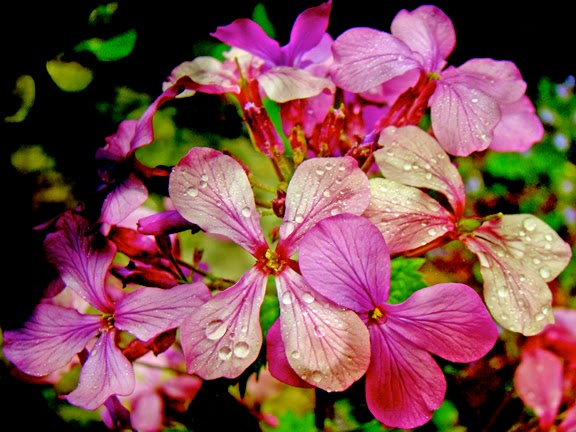
Lunaria, or Money Plant, is a late springtime bloomer in our yard.  Most flowers are white but a few are this lovely pink.  The dried seed pods are much desired for decoration and dried bouquets.
http://www.illinoiswildflowers.info/weeds/plants/money_plant.htm


The Deptford Pinks begin blooming here in late June.  they are a low and lanky plant, growing to about 18 inches tall, sometimes more.  http://www.illinoiswildflowers.info/weeds/plants/deptford_pink.htm 

Another common name for these little beauties is Mountain Pink
There are something like 250 species in this family of flowers, but bindweed is the most common name I know.  They like full sun, are a vine, and will tangle themselves around anything that offers support.  Gardeners and farmers alike curse the plant and consider it a terrible pest.  It is lovely (most of the plants flower in white but many are pink) but pernicious - never quits!  They bloom from late spring into fall. This was growing amongst thistles in a field.  http://www.illinoiswildflowers.info/weeds/plants/field_bindweed.htm
 
Joe Pye Weed is getting more and more scarce as years go by.  Where once there were huge areas filled with it, now there are houses, roads, or they've been mowed down.  This is sad because the plant offers butterflies, moths, bees, wasps, and other insects a meal, a place to hunt, and hiding places.  It's a big plant growing up to 7 feet tall, blooms summer into fall, and needs reliably moist soil.  I can tell you it grows very well in full sun to light shade.  This is a GORGEOUS plant and would be beautiful in a landscaping scheme.  It's relatively problem free, blooms like crazy, and doesn't need attention.  I've seen white flowers as well as this pretty mauve/pink.  Consider it as a wonderful addition to your garden:>)  http://www.missouribotanicalgarden.org/PlantFinder/PlantFinderDetails.aspx?kempercode=c740
 
This and the next few pictures are not flowers and are not pink (Did you guess that already?) but are some of my favorite things:>)  These are the fruiting bodies of various mosses.  Instead of seeds, mosses produce spores.  When the spores are mature they are released on the breezes to spread the moss.  I LOVE the many shapes and colors of these fruiting bodies and have wayyyyyy too many pictures of them - LOL>

Here is a quote from the site given below. 

What is a moss?

A moss is a class (Musci) of plants without flowers or roots. Moss usually grows as low, dense, carpet-like masses on tree trunks, rocks, or moist ground.
Language of Flowers: Moss means "maternal love". 
http://www.ontariowildflower.com/moss.htm

Small but mighty! The fruiting bodies of moss are the capsules where the spores are grown. They can look like globs or cylinders, and are generally held above the carpet of moss on long, delicate stalks. Beautiful shapes and colors!


Roses are another wildflower that grows profusely and not only beautifies the landscape but fills the air with perfume.  Again, there are many kinds and not all are beloved.  Although I like the wild, multiflora rose, for example, many people fight to get rid of it.  It is an introduced and invasive plant, but it has that other, wonderful side.  Blooming is barely more than a couple weeks long, but those weeks are awesome - white flowers everywhere and the air is heavenly.  Each bit of wind carries the scent throughout the area.  Because the flowers are white, this particular rose is not shown.  http://www.nps.gov/plants/alien/pubs/midatlantic/romu.htm

The roses here are field roses of various sorts.  There are white ones, too, and roses that thrive at the shore in all the salt spray and sand.  Roses are tough cookies and can survive tough conditions!


The Wild Geranium is such a pretty wildflower!  May/June is blooming time in Green Lane and I look forward to having them brighten our yard every year.  When growing in a colony they are impressive - all those delicate, pink flowers on the dark green foliage.  They are about 1-1/2 feet high and can easily be grown in a wildflower garden with rich, reliably moist soil.  We live in the woods so ours are in partial shade and like it fine.  I've also seen them in full sun just loving life.  For more info you can visit here:
http://www.missouribotanicalgarden.org/PlantFinder/PlantFinderDetails.aspx?kempercode=c850

Wild Geranium, Crane Flower
In May/June we have the blooming explosion of Wild Phlox.  In a good year there are wide swaths of these stunning plants flowering their white, purple, and pink hearts out.  I collected ripe seed pods in September and met with a small amount of planting success, and transplanting hasn't been great either so now I enjoy them where they grow.  Maybe I'll buy seeds some day.  They don't seem to like full sun and ours like to grow near creeks, pondside, and in ditches.  They do grow away from water, too, but aren't as lush.  You can get information on these lovely plants here:
http://www.missouribotanicalgarden.org/PlantFinder/PlantFinderDetails.aspx?kempercode=e580


Indian Pipes are actually blooming wildflowers, not fungi as many assume from their appearance.  A second common name for them is Corpse Plant because they rapidly turn black when touched.  These are unusual wildflowers as they get their nutrition from fungi that have a symbiotic (mostly mutually beneficial) relationship with plants - mainly trees, I believe.  They are white because there is no chlorophyll-making ability in these plants.  How lovely to find these delicate flowers growing in the woods.  Sun is not their friend so search for them in shaded, moist areas.  There is a more scarce version that is pinkish.  Some of ours have a slightly pink tint but not as strong as other images I've seen.
http://en.wikipedia.org/wiki/Monotropa_uniflora


All white version

Pink tinted version
More pink


Seed heads of the Indian Pipe plants


@@@@@@@@@@@@@@
 Venus Looking Glass

These lovely members of the Bellflower family grow wild in dry, sunny places.  They are leggy, being slender and about a foot tall, and have these pretty, purple flowers that open rising up the stalk as the older flowers below die off.  They enjoy poor soil like old railroad tracks or overgrown fields, but must have plenty of sun to thrive.

They bloom, in our area, June and July, and this picture was taken July 4, 2013, in Green Lane, Pennsylvania, USA. 


For more information you can read a lovely little write up here:


http://www.illinoiswildflowers.info/prairie/plantx/venusx.htm
Venus Looking Glass
The majority of the Queen Anne's Lace hereabouts are white with a red center.  I'm including this picture to show the pink on the outermost buds.  I love these flowers, especially when they bloom in concert with the blue chicory (cornflower).  This plant is an introduced, very successful wildflower that is considered a noxious weed by some folks.  The plant can grow tall, up to3 feet, and loves full sun and waste areas.  It blooms in the second year of growth (biennial) and is in flower all summer long.  What more can you ask of a plant but to have it grow where nothing much else thrives and to be beautiful as well.  It does resemble the dangerously poisonous Water Hemlock (suggested this is what killed Socrates) so look for the red dot in the middle of the flower head to be sure you aren't messing with a deadly - YES, DEADLY! - plant.

http://uswildflowers.com/detail.php?SName=Daucus%20carota

http://www.fcps.edu/islandcreekes/ecology/queen_annes_lace.htm

Here is a site for information on the Water Hemlock - always be well-armed with knowledge:>)  There is nothing to fear if you know about the plant/mushroom.bug/animal and deal with it with respect.

http://www.friendsofthewildflowergarden.org/pages/plants/waterhemlock.html 

http://www.illinoiswildflowers.info/wetland/plants/water_hemlock.htm

Queen Anne's Lace
There are a few types of Ironweed.  I'm giving this the ID of "New York, Ironweed" because it has the fuzzy looking flowers and is really, really tall:>).  This specimen is growing in a field in Green Lane, Pa, USA, and the picture was taken September 3, 2011.

Ironweed attracts a large number of insects, especially butterflies, bees, and wasps.  It is handsome (as you see), and although it reminds me of a thistle it is actually a member of the aster family.  The name Ironweed comes from the persistence of the stems through the winter.  It is a perennial - a strong, tall plant that likes moist fields and meadows with lots of sunshine.

For more information go to:

http://plants.usda.gov/java/profile?symbol=VENO

http://www.ppws.vt.edu/scott/weed_id/venno.htm

Purple Loostrife is gorgeous but terribly invasive.  It was introduced and now is taking over.  This quote is taken from the Wikipedia write up linked below:  "The purple loosestrife has been introduced into temperate New Zealand and North America where it is now widely naturalized and officially listed in some controlling agents. Infestations result in dramatic disruption in water flow in rivers and canals, and a sharp decline in biological diversity as native food and cover plant species, notably cattails, are completely crowded out, and the life cycles of organisms from waterfowl to amphibians to algae are affected. A single plant may produce up to 2.7 million tiny seeds annually. [10] Easily carried by wind and water, the seeds germinate in moist soils after overwintering. The plant can also sprout anew from pieces of root left in the soil or water. Once established, loosestrife stands are difficult and costly to remove by mechanical and chemical means.
Plants marketed under the name "European wand loosestrife" (L. virgatum) are the same species despite the different name. In some cases the plants sold are sterile, which is preferable.
In North America, purple loosestrife may be distinguished from similar native plants (e.g. fireweed Epilobium angustifolium, blue vervain Verbena hastata, Liatris Liatris spp., and spiraea (Spiraea douglasii) by its angular stalks which are square in outline, as well by its leaves, which are in pairs that alternate at right angle and are not serrated.

http://en.wikipedia.org/wiki/Lythrum_salicaria

There are so many kinds of thistle plants that I'm rather at a loss on this exact ID.  Some thistles have malicious thorns, others have no thorns.  Some are invasive and not welcomed in places while others beautiful our landscape in a lovely display of pink/purple flowers.  they have seed that are like the dandelion seeds - fluffy and designed to travel on the breezes.
Thistle - I can only give you the generic name - sorry.

http://en.wikipedia.org/wiki/Thistle

It's summer and I find myself woefully short on time to do anything - sound familiar?  Blog posts will be catch-as-catch-can until fall, perhaps, but I'm going to try to have new posts fairly often, just not on a schedule.


If you read the blog and haven't signed up, sign up is an easy way to be notified when a new post is published.  It is invisible to me who signs up.  To help you I've made 3 screen shots of the email sign up process. (I did it just so I'd know what happens and could show you what to expect.)


On any blog page - upper right side above the listing of popular posts you'll see this:


Enter your email address and press "SUBMIT".

The next screen looks like this:


Enter the squiggly, annoying secret code and press "COMPLETE SUBSCRIPTION REQUEST".

You will get the final screen which looks like this:


Close the window.  When your email requesting verification that you really want to be signed up arrives in your in box, it will look like this (the highlighting is mine, not theirs):

Hello there,

You recently requested an email subscription to Nature's Wonders. We can't wait to send the updates you want via email, so please click the following link to activate your subscription immediately:

http://feedburner.google.com/fb/a/mailconfirm?k=y9uq26PaqllZAaYXHYIfBGVzXsA

(If the link above does not appear clickable or does not open a browser window when you click it, copy it and paste it into your web browser's Location bar.)

As soon as your subscription is active, FeedBurner will send a daily email message if Nature's Wonders has new content.

If you did not request this subscription, or no longer wish to activate it, take no action. Simply delete this message and that will be the end of it.

Cheers,

Nature's Wonders


--
This message was sent to you by FeedBurner (feedburner.google.com)
You received this message because you requested a subscription to the feed, Nature's Wonders.
If you received this in error, please disregard.  Do not reply directly to this email.


Click on the enclosed link and you're done:>)  It tells you that if new content is published they will notify you via email.  No new content, no email, no bother.

Okay - I'm off to the shower and then the grocery store.  I'm so pleased you're here reading this blog:>)

Thank you - see you soon!